


Resource Type: Blogs
Tag: Fulfilment
Why Better Decisions Matter More Than Bigger Warehouses.
UK enterprise now wins on operational intelligence, not the size of your warehouse. It's the decisions that you make when managing the complexities of logistics in 2026 that creates a competative advantage.
August 7, 2026
Resource Type: Blogs
The UK Enterprise Fulfilment Stack in 2026
Why Better Decisions Matter More Than Bigger Warehouses.
UK enterprise now wins on operational intelligence, not the size of your warehouse. It's the decisions that you make when managing the complexities of logistics in 2026 that creates a competative advantage.
August 7, 2026
Contents
Contents
Contents
Contents
For twenty years, UK fulfilment has answered every problem with the same solution: more space. Sales up? Lease another warehouse. Customers getting impatient? Sign another carrier, open another region, pour another concrete slab.
It wasn't a bad strategy. It was just the only one anyone needed. Ecommerce was young, next-day delivery still felt like magic, and the job was simple: keep up with demand.
That job doesn't exist anymore.
Walk onto a warehouse floor today and space isn't the problem. Nobody's short on square footage. What they're short on is the ability to keep track of what's actually happening inside their own operation. Orders are landing from Shopify, Amazon, TikTok Shop, and half a dozen wholesale accounts at once. Customers want it there tomorrow and will complain the moment the tracking page goes quiet. Carriers keep consolidating, labour costs aren't coming down, and every one of these decisions is quietly eating into margin whether anyone's watching or not.
So here's the uncomfortable part for anyone who's spent the last decade building bigger sheds: the businesses pulling ahead now aren't the ones with the most warehouse space. They're the ones making better calls, faster, thousands of times a day.
The Shift From Speed to Operational Intelligence
For decades, 3PLs competed on two things: how fast and how far. Today, both are table stakes, everyone can get a parcel there next day. That was the hard part in 2015.
The UK is now one of the most demanding ecommerce markets on the planet: deep digital adoption, buying journeys fractured by social commerce, customers who expect speed and transparency as a baseline, not a perk. Moving the box isn't the hard part anymore. The hard part is the thousands of small decisions that happen before the box ever moves.
Which means the question senior ops leaders should be asking a logistics partner has changed. It's no longer "how many square feet do you have?"
Instead it is: does your technology actually help us make better decisions before problems show up on the floor? Four worth asking before you sign anything:
- Can inventory be rebalanced across channels before a hot SKU runs dry?
- Can carriers be swapped instantly the moment service drops in a region?
- Can labour and automation shift before a bottleneck chokes outbound?
- Can you go live on a new marketplace tomorrow, or is that a six-month integration project?
If the answer to any of those is "we'd need to check," you don't have a modern supply chain. You have a big warehouse network that's very good at managing complexity it should be removing.
Two Philosophies
Look at how enterprise logistics technology actually gets built, and you'll find two very different starting points.
The Corporate Technologist | The Integrated Operator |
The first comes from the world's biggest contract logistics providers. Their platforms run enormous global networks; millions of signals a day, across hundreds of sites, wrapped in the language of AI and "unprecedented visibility." It's genuinely impressive engineering, and if you're coordinating thousands of customers across three continents, it's exactly what you'd want to build. But technology built by a logistics provider, for a logistics provider's network, optimises for that network. Not for you. No ops director has ever lain awake wondering how many signals their platform processed last night. They lie awake wondering whether they'll have enough hands on deck for peak, whether margin survived the last carrier price rise, and whether the marketplace their MD just signed can actually go live without a six-month rebuild. Visibility is nice. Outcomes are the job. | The second starts somewhere less glamorous: on the concrete floor of a warehouse, at 2am, during Black Friday peak. It starts when a picker is standing idle because two systems won't talk to each other. It starts when a customer service rep has to explain why the website let someone buy something that wasn't actually there. It starts when a carrier misses a collection and a few thousand next-day promises are suddenly stuck on a loading dock. Nobody in that room is thinking about data platforms. They're thinking about the next ten minutes. Build software from that vantage point and you ask a different question, not "how do we build an impressive AI platform?" but "how do we stop this exact thing from happening again, tonight?" Small distinction. Changes everything about what gets built. |
Why Operator-Built Technology Creates Different Outcomes
The best fulfilment platforms rarely start life as a spec document. They start as a fix for something that was actively going wrong. That's how technology built inside a real ecommerce operation tends to evolve; someone on the floor finds a better way to do something, an integration closes a gap that was costing real money, and only later does anyone think to sell it as software. It's built backwards from most software, and it shows.
Carrier routing is the clearest example. Lock a brand into one carrier contract and you've built in a single point of failure. An operator-built system instead treats every parcel as its own decision, checking in real time which carrier is actually performing well right now, and rerouting instantly if one starts slipping in a region. The customer never notices. The brand never has to explain itself to a hundred angry inboxes.
Good software tells you what went wrong. Great software makes sure you never find out.
Warehouse Automation Isn't the Story Anymore
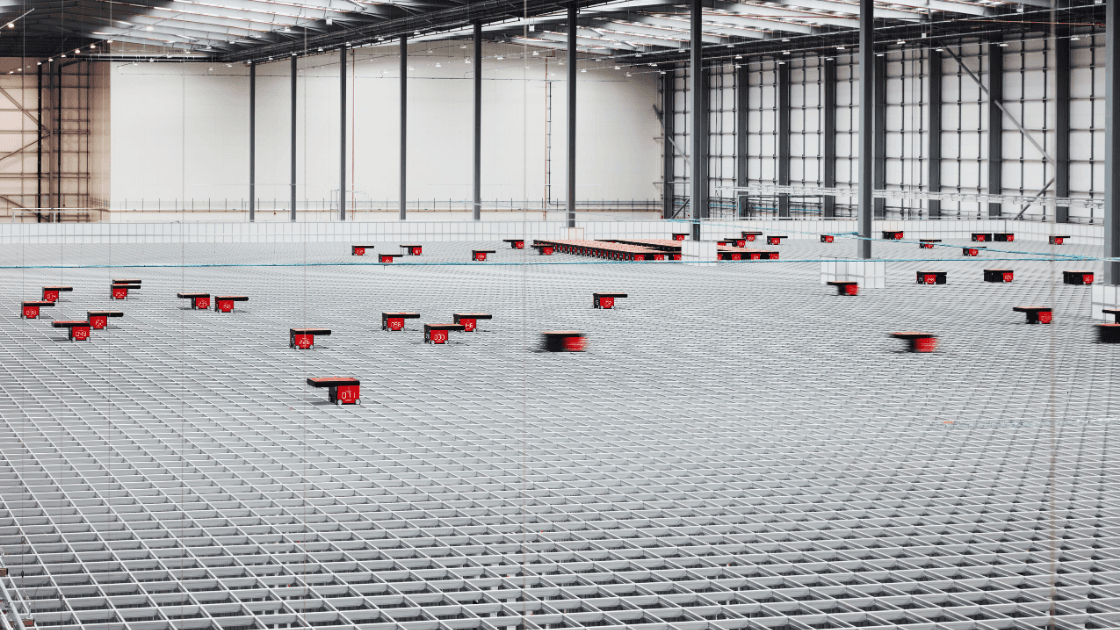
Automation is probably the most overrated conversation in logistics right now, not because the robots don't work, but because they've stopped being what separates anyone from anyone else. Cube storage, autonomous mobile robots, smart sorting: nearly every serious enterprise provider has some version of all three. It's the price of entry, not the edge.
The actual differentiator is dumber and harder: does the software know, at every second, what every robot, conveyor, picker and carrier should be doing next? Without that, you can have the best hardware money can buy and still underperform, because nothing's talking to anything else. The best operations aren't the ones with the most robots. They're the ones with the least friction between them.

When we brought automated sorting onto our outbound lines at THG Fulfil, installing the hardware was the easy part. The real work was rewriting the routing logic to match how our floor actually moves, which is what took us from 250,000 to 600,000 units a day in 35 days, at 99.9% uptime. Not the machines on their own. The machines and the logic working as one system.
The Next Era of Enterprise Logistics
Technology has never mattered more in logistics, and its job has never been simpler to state: make the operation feel less complicated, not more. The best platforms don't try to impress you with architecture diagrams. They just make problems disappear before you have to think about them; fewer manual steps, fewer wasted clicks, fewer 3am surprises, and warehouse teams spending their time moving product instead of fighting five systems that don't talk to each other.
Nobody buys software because it has AI in it. They buy it because it lets them sleep during peak week, expand into a new market without ripping out the stack, and actually keep the promises they made to customers.
The next chapter of UK enterprise logistics won't be won by whoever owns the most warehouses. It'll be won by whoever builds the better decisions inside them. That's the whole game now and most of the industry hasn't caught up yet.
Curious what your fulfilment stack could actually do?
Get in touch with the team at THG Fulfil and see what you're truly capable of.