


Resource Type: Blogs
Tag: Fulfilment
BLOG
The way warehouses operate is changing, and AI is at the centre of it. From smarter demand forecasting to dynamic inventory placement to predictive maintenance and robotics orchestration, discover how the latest wave of warehouse automation is helping ecommerce brands scale faster, reduce cost-to-serve, and achieve near-perfect accuracy.
April 2, 2026
Resource Type: Blogs
BLOG
AI in Warehouse Automation: A Defining Shift for Ecommerce Operations in 2026
The way warehouses operate is changing, and AI is at the centre of it. From smarter demand forecasting to dynamic inventory placement to predictive maintenance and robotics orchestration, discover how the latest wave of warehouse automation is helping ecommerce brands scale faster, reduce cost-to-serve, and achieve near-perfect accuracy.
April 2, 2026
4 min read
A shift that goes beyond efficiency
There’s a tendency in our industry to label every new development as transformational. Most of the time, it isn’t. It improves efficiency, adds incremental value, but the fundamentals stay the same. AI in warehouse automation feels different.
For years, automation has been about mechanising tasks. Pick faster, move goods more efficiently, reduce reliance on labour. While this is an absolute imperative in choosing the right automation partners, we are also seeing a shift in mindset, AI is beginning to influence how decisions are made in operations and not just execution and how tasks are carried out.
At the same time, the pressure on fulfilment is increasing. Ecommerce volumes continue to grow at pace, while SKU counts and order complexity are rising even faster. Leading automated systems are already delivering up to 4x storage density and significant improvements in picking productivity, which means the gap between what’s possible and what many operations are currently running is widening.
At THG Fulfil, the conversation has already moved on from whether to automate.
We believe that most brands are already somewhere on that journey. The real question now is how fulfilment operations keep up with that complexity, without constantly adding cost or risk.
From executing plans to adapting in real time.
Powerful Benefits to AI warehouse automation.
Traditionally, warehouses have been built to execute a plan. Forecasts are created, capacity is allocated, and the operation delivers against that structure. The challenge is that ecommerce doesn’t behave in predictable ways anymore.
Demand shifts quickly, product velocity changes, and channel mix evolves in ways that are difficult to model in advance. AI introduces the ability for the operation to respond in real time, rather than relying purely on assumptions made weeks or months earlier.
Forecasting that shapes operations
You can see this most clearly in how forecasting is starting to change. It’s no longer something that sits outside the warehouse as a planning exercise. Instead, it becomes part of the operation itself, continuously adjusting and feeding into decisions around inventory placement, labour planning and capacity management.
Operators using AI-driven forecasting are already seeing meaningful improvements in forecast accuracy, which translates directly into smoother peak periods and fewer last-minute interventions.
Breaking the link between growth and cost: Productivity gains
Historically, growth in order volume has brought a predictable set of challenges. More orders mean more people, more space, and more pressure on the operation.
AI starts to break that relationship by making better use of what already exists. By continuously optimising picking logic, routing decisions and system load, it allows the warehouse to handle more volume without the same linear increase in cost.
In highly automated environments, this can translate into productivity gains of 2–3x compared to manual or semi-automated setups, which fundamentally changes the cost-to-serve as brands scale.
Accuracy that is built into the system
Accuracy is another area where the change is subtle but important. In many operations, accuracy still depends heavily on manual processes and individual performance. As SKU ranges expand and orders become more complex, that becomes harder to sustain.
AI shifts accuracy into the system itself, learning from patterns, adjusting how decisions are made, and reducing the likelihood of errors before they happen. Combined with robotics and automated sortation, this is how leading operations are consistently achieving near-perfect accuracy levels, even at scale.
Designing out downtime
In highly automated environments, even small disruptions can have a disproportionate impact. Traditionally, maintenance has been reactive, issues are fixed once they occur.
With AI, supported by data from robotics and conveyor systems, it becomes possible to identify early warning signs and act before failures happen. Some automated systems are already reporting uptime levels above 99%, and AI is a key factor in maintaining that consistency as operations scale.
One connected, adaptive operation
What ties all of this together is the way the operation starts to behave as a single, connected system. Forecasting, inventory placement, picking and dispatch are no longer separate layers. They begin to inform each other in real time, creating a feedback loop where the system is constantly adjusting based on what’s happening on the floor. Over time, that reduces the need for manual intervention and creates a much more responsive operation.
Why THG Fulfil is one of the top Automation partners
We dispatch over 150 million units annually to 19 million customers across 195 countries.
Faster deployment and faster time to value
One of the biggest barriers to automation adoption is fragmentation. Multiple systems, multiple vendors, and complex integration requirements introduce risk and slow down execution.
THG Fulfil removes that complexity by unifying the entire ecosystem through a single, proprietary technology layer:
- OMS and WMS directly connected to robotics control
- Courier management across 250+ integrations
- Built-in cross-border and regulatory capabilities
This creates a fully orchestrated execution layer, where automation, software, and fulfilment operations are designed to work together from day one.
The result is faster deployment, reduced integration risk, and significantly shorter time to value compared to traditional multi-vendor implementations.
A different approach to automation infrastructure
The most effective fulfilment environments today are not built around a single technology. They are designed as integrated ecosystems, combining the strengths of multiple automation partners into one coordinated operation.
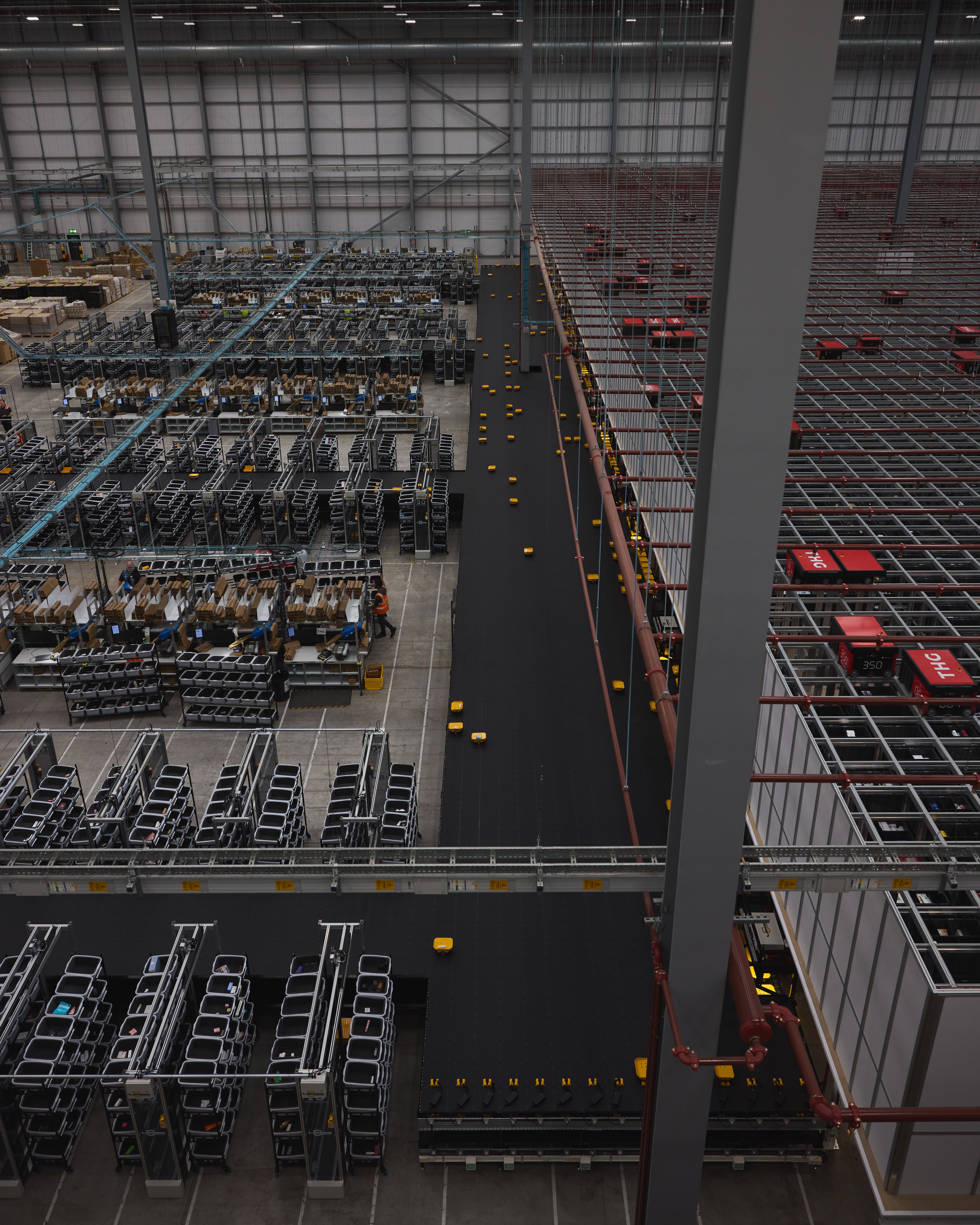
Grid-based storage systems such as AutoStore deliver density and efficient goods-to-person picking. Robotic picking and handling solutions from Geek+ introduce flexibility and scalability across workflows. High-speed sortation technologies, such as Libiao’s 3D sorting systems, enable rapid order consolidation and dispatch.
Individually, each technology delivers value. Combined, and orchestrated through a single operational layer, they create a far more powerful system capable of handling complexity, scale and speed simultaneously.
At THG Fulfil, the differentiator is not the technology itself, but how it is integrated, controlled and continuously optimised as one operation. This is enabled through a proprietary technology stack that connects every layer of fulfilment, from order management through to robotics execution.
AI is applied across the full lifecycle, not as a standalone feature, but as the intelligence layer that drives performance:
- Predictive demand forecasting to anticipate volume and optimise inventory positioning
- Dynamic slotting and pick strategy optimisation based on real-time conditions
- Intelligent orchestration of robotics, sortation and order flow
- Continuous performance optimisation across the network
Because the entire system operates through a single execution layer, improvements can be deployed faster, and the operation can adapt in real time as demand evolves.
Just as importantly, this model removes many of the traditional barriers to automation. Instead of requiring significant upfront investment and long implementation cycles, brands can access advanced automation infrastructure through more flexible, light-capex models.
The result is faster deployment, reduced risk, and a much shorter path to value, without compromising on long-term scalability.
Immediate access to automation, without the CapEx constraint
As the only AutoStore distributor offering a Robotics-as-a-Service model alongside a fully integrated commerce and fulfilment stack, brands can access advanced automation infrastructure without the need for significant upfront investment.
This provides immediate access to technologies such as AutoStore, Geek+ robotics, and Libiao sortation, all orchestrated through a single platform.
The impact is commercial as much as operational. Brands can move faster, scale sooner, and realise value earlier, without being locked into long transformation cycles or capital-intensive programmes.