


Resource Type: Blogs
Tag: Fulfilment
BLOGS
AutoStore or AMRs — two technologies, one critical decision. Get it wrong and you're locked into infrastructure that doesn't fit your operation. Here's an honest comparison of both, from a team that operates them every day.
June 16, 2026
Resource Type: Blogs
BLOGS
AutoStore vs AMRs: Which Warehouse Automation System Is Right for Your Ecommerce Operation?
AutoStore or AMRs — two technologies, one critical decision. Get it wrong and you're locked into infrastructure that doesn't fit your operation. Here's an honest comparison of both, from a team that operates them every day.
June 16, 2026
Two technologies are dominating conversations about warehouse automation in ecommerce right now. AutoStore — the cube-based automated storage and retrieval system (ASRS) — and Autonomous Mobile Robots (AMRs), the floor-level, rack-moving robots that have rapidly become a fixture in modern fulfilment centres.
AutoStore: Cube-Based ASRS
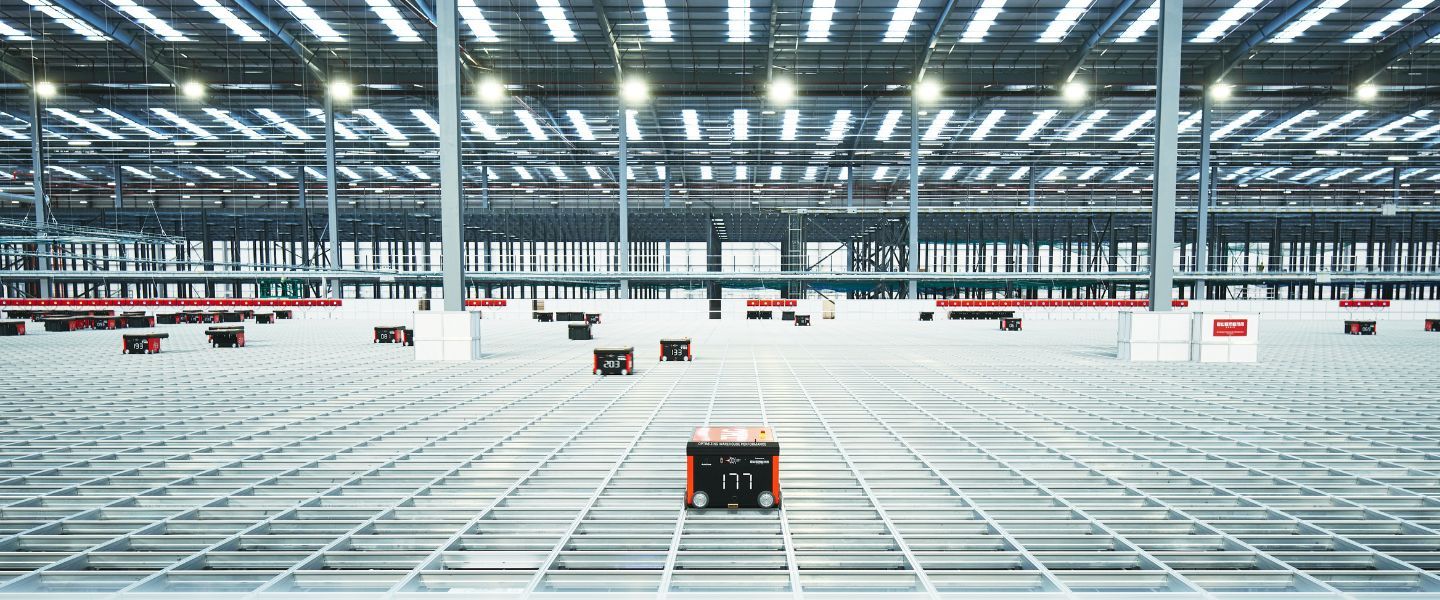
AutoStore is a goods-to-person system built on a dense aluminium grid. Inventory is stored in bins stacked vertically within the grid. Small autonomous robots run across the top of the grid, retrieving bins from below and delivering them directly to operators at picking workstations — called ports — around the perimeter.
There are no aisles, no pick walks, and no human access inside the storage area. The system is entirely enclosed. Inventory moves to the operator, not the other way around. With more than 1,300 systems deployed globally, AutoStore is the world's most widely adopted cube storage system, trusted by leading retail and ecommerce brands across multiple sectors.
AMRs: Autonomous Mobile Robots
AMRs are floor-level robots that navigate dynamically using sensors, cameras, and AI — without fixed paths or magnetic guides. In a warehouse context, they typically transport mobile shelving units or totes from storage areas to picking stations, or assist human pickers by following them through the warehouse and carrying their picks.
Unlike older Automated Guided Vehicles (AGVs), which follow predetermined routes, AMRs adapt in real time to their environment — navigating around obstacles, recalculating routes, and operating alongside human workers. They require significantly less fixed infrastructure than an ASRS and can typically be deployed faster and at lower upfront cost.
AutoStore vs AMRs: A Direct Comparison
AutoStore (ASRS | AMRs | |
| Space Efficiency | Up to 75% less space than traditional shelving. Vertical cube storage maximises every cubic metre. | Floor-level only. Requires aisle clearance and significantly more footprint per SKU stored. |
| Throughput | Engineered for high-volume, high-speed DTC. World's fastes goods-to-person system. | Generally suited to medium-to-low throughput environments. Not optimal for high-speed, high-volume DTC. |
| Picking Accuracy | 99.99%. Fully scanned inventory movements at every stage. | High accuraccy possible but dependent on system design and human-robot interaction points. |
| Uptime | 99.9% global uptime. Independently controlled modules means faults are isolated, not systemic. | High upptime possible. However, floor-level operation means obstacles and collisions can disrupt performance. |
| Deployment Speed | Longer lead time. Significant infrastructure installation required. | Faster deployment. Minimal fixed infrastructure. |
| Scalability | Modular. Robots and bins added independently without shutting down operations. | Scalable. Additional robots added to the fleet without major infrastructure change. |
| SKU Density | Exceptional. Dense bin-based storage handles vast SKU libraries within a minimal footprint. | Good. Floor-level rack storage is less space-efficient at scale. |
| Product Safety | Enclosed system. Inventory stored securely within bins, protected from human traffic and environmental exposure. | Open floor environment. Greater exposure to damage from robot or human traffic. |
| CapEx / OpEx | Higher initial investment. Available via THG Fulfil's RaaS model to convert to OpEx. | Lower upfront cost. RaaS models widely available. Accessible for smaller operations. |
| SKU / Product Type | Optimised for small-to-medium items within bin dimensions. Ideal for higher SKU count, lower unit size - cosmetics, supplements, fragrances, accessories, small electronics. | Handles a broader range of item sizes and weights, including larger or irregular products. Better suited where SKU profiles are diverse, frequently changing, or include bulkier items. |
| Inbound Goods Handling | Requires a decanting step. Inbound goods must be sorted into bins before entering the grid. An additional process stage that needs to be resourced and planned for. | Can often handle inbound goods more directly with less pre-processing, depending on system configuration. A meaningful operational advantage for high-inbound-volume operations. |
| Fragile / High-Value Products | Enclosed bin-based system minimises handling touchpoints and environmental exposure. A strong advantage for fragile glass, premium packaging, and high-value inventory (e.g. luxury beauty, fine fragrance). | Open warehouse floor environment with more handling touchpoints. Manageable with the right protocols, but structurally higher risk for fragile or high-value goods. |
| Best Suited For | High-volume DTC and B2B ecommerce; operations with extensive SKU libraries; brands scaling for peak; fragile or high-value product categories. | Operations requiring layout flexibility; lower-throughput environments; broader product size ranges; brands in early automation stages. |
Where AutoStore Has a Clear Advantage
High-volume, high-speed DTC fulfilment
AutoStore is engineered for throughput at scale. Its goods-to-person design eliminates manual pick walks entirely, and the system can operate continuously — 24 hours a day, 7 days a week — with a global uptime rate of 99.9%. For ecommerce brands processing thousands of orders daily, this level of sustained throughput is difficult to replicate with floor-level AMR systems, which AutoStore's own technical documentation acknowledges are generally not optimal for high-throughput, high-speed environments.
THG Fulfil operates the world's highest-output DTC AutoStore facility, processing up to one million units per day across our network. That is not a theoretical specification — it is a validated operational reality.
Space-constrained operations with large SKU libraries
AutoStore uses up to 75% less floor space than traditional shelving, storing inventory vertically within a dense cube. For brands managing thousands of SKUs — whether that is a beauty brand with extensive shade ranges, a nutrition brand with multiple product formats, or an electronics brand with broad accessory lines — this density is operationally transformative. More SKUs, smaller footprint, lower cost per unit stored.
AMRs operate at floor level and require aisle clearance for navigation. In a space-constrained facility, this limits how much inventory can be held relative to the available square footage.
Product integrity and security
AutoStore's enclosed design protects inventory from exposure to human traffic, floor-level activity, and environmental factors. Bins are sealed within the grid, and every inventory movement is fully scanned — delivering 99.99% picking accuracy. For categories where product integrity is non-negotiable — fragrance, skincare, glass packaging, nutritional supplements — this level of protection matters significantly.
In an AMR environment, shelving units and totes move through open warehouse floor space alongside human workers and other vehicles. The risk of damage, contamination, or mis-pick, while manageable, is structurally higher.
Peak resilience at enterprise scale
AutoStore's modular architecture allows additional robots and bins to be integrated without shutting down operations. The independently controlled robot modules mean that if one robot encounters a fault, it is isolated — the system continues to run. For brands facing significant peak trading periods — whether that is Black Friday, a major product launch, or a viral demand spike — this resilience is a genuine operational advantage.
Where AMRs Have a Clear Advantage
Speed of deployment
AMR systems require significantly less fixed infrastructure than AutoStore. Some systems can be deployed in a matter of weeks, with minimal construction or structural modification to the warehouse. For brands that need to automate quickly — or that are not yet ready to commit to a permanent infrastructure investment — AMRs offer a faster path to operational improvement.
Flexibility and layout adaptability
Because AMRs navigate dynamically rather than operating within a fixed grid, they can adapt more readily to changes in warehouse layout, SKU profile, or operational requirements. If your product range changes significantly, or if you need to reorganise the warehouse to accommodate new operations, AMRs are generally easier to reconfigure than a fixed ASRS installation.
Lower entry point for early-stage automation
The upfront cost of an AutoStore installation is higher than most AMR deployments. For brands in the early stages of automation — or those with lower order volumes that do not yet justify enterprise-scale ASRS — AMRs offer a more accessible entry point. RaaS models are widely available for both technologies, but AMRs typically carry a lower baseline cost per robot.
The Most Sophisticated Answer Is Often Both
The framing of AutoStore vs AMRs can be misleading, because in many high-performing fulfilment operations, both technologies co-exist and complement each other. AutoStore handles the dense, high-velocity storage and retrieval at the core of the operation. AMRs manage peripheral tasks — transporting consolidated orders to packing stations, handling inbound goods, managing outbound staging — where their flexibility and lower infrastructure requirements are an advantage.
THG Fulfil's robotics ecosystem reflects this logic. Our AutoStore installations are complemented by Geek+ autonomous robots, which manage goods-to-person operations for broader, more dynamic SKU profiles — including hanging garments, pallet bases, and multi-shelf rack structures. Together, they form an integrated automation layer, orchestrated by our proprietary Warehouse Control System and Voyager WMS, rather than operating as disconnected technologies.
The question is rarely which technology to choose. It is which technology to deploy where — and who has the operational experience to make that integration work.
Beauty brands present a specific set of automation challenges that make the AutoStore vs AMR decision particularly consequential. High SKU counts across shade ranges, formats, and seasonal launches; product fragility in glass and premium packaging; multi-item order profiles; and the constant risk of viral demand spikes all point strongly towards the structural advantages of AutoStore — specifically its density, accuracy, and throughput resilience.
That said, beauty operations with significant outbound complexity — high-volume gift set assembly, large-scale kitting programmes, or rapid sample pack fulfilment — may benefit from AMR or sortation technology alongside an AutoStore core. The right answer depends entirely on the specific order profile, SKU velocity curve, and throughput requirements of the individual operation.
THG Fulfil is both an authorised AutoStore Distributor and an operator of one of the world's most advanced multi-technology robotics environments. That means we have a perspective on this question that is rooted in operational experience rather than vendor preference.
We have designed, installed, and operated AutoStore at enterprise scale. We run Geek+ AMR fleets. We have deployed Libiao T-Sorter technology that increased our outbound capacity by 25% and scaled batch output from 42 orders to 3,800 per cycle. And we have integrated all of these systems under a single proprietary software layer — our WCS and Voyager WMS — that orchestrates them as one operating system rather than a collection of disconnected tools.
When a brand approaches us about automation, we start with the operation — not the technology. What is your current throughput? What does your SKU profile look like, and how is it likely to evolve? What are your peak trading demands? What is your facility footprint, and does it have the height to maximise an AutoStore installation? What is your timeline and capital structure?
The answers to those questions determine the right technology mix. Sometimes that is AutoStore alone. Sometimes it is AMRs, or a combination. Sometimes — particularly for brands not yet at enterprise scale — it is Pio, AutoStore's plug-and-play system, which brings goods-to-person automation to smaller operations without the infrastructure requirements of a full installation.
What it is never is a one-size-fits-all answer — and any partner who tells you otherwise is selling technology, not solving your problem.
Talk to Us About Your Automation Strategy
Whether you are evaluating automation for the first time, looking to upgrade from an existing AMR deployment, or considering a full AutoStore installation, THG Fulfil's team has the operational depth to help you make the right decision for your business.
We manage the entire process: from needs assessment and system design, through to installation, integration, training, and ongoing optimisation. And because we operate these systems in our own facilities every day, the advice we give you is grounded in real-world operational experience.
Get in touch to discuss what the right automation strategy looks like for your operation.