


Resource Type: Blogs
Tag: Fulfilment
BLOGS
Rising labour costs. Mispicks. A peak season that nearly broke your operation. If any of these sound familiar, your warehouse is telling you something. This is a direct comparison of manual picking vs AutoStore, and what the numbers mean for your bottom line.
June 8, 2026
Resource Type: Blogs
BLOGS
AutoStore vs Manual Picking: How Warehouse Automation Cuts Costs, Errors and Labour Dependency
Rising labour costs. Mispicks. A peak season that nearly broke your operation. If any of these sound familiar, your warehouse is telling you something. This is a direct comparison of manual picking vs AutoStore, and what the numbers mean for your bottom line.
June 8, 2026
There is a moment in the growth of every ecommerce business when the warehouse stops being a back-office function and starts being a strategic problem.
It usually arrives in one of three ways:
- Orders are scaling faster than your team can handle.
- Labour costs are rising and headcount is becoming your primary lever for growth.
- You are preparing to enter a new market, and the fulfilment infrastructure you have built for the UK is not going to work in the US or Europe without significant reinvention.
When that moment arrives, the question of whether or not to automate stops being a technology debate. It becomes a business decision.
For some brands, the manual warehouse model often looks deceptively manageable. Order volumes are high enough to need significant warehouse resource, but not yet so high that the inefficiencies are obviously catastrophic. Labour costs are a growing line item, but still budgetable. Peak trading is painful, but survivable.
The risk is staying in this position too long. Manual operations do not scale gracefully. The cost and complexity of running them grows disproportionately with volume, and the operational quality they deliver (pick accuracy, speed, consistency), degrades under pressure precisely when consumer expectations are the highest.
By the time a manual warehouse becomes an obvious problem, it is already costing you customers.
What is AutoStore?
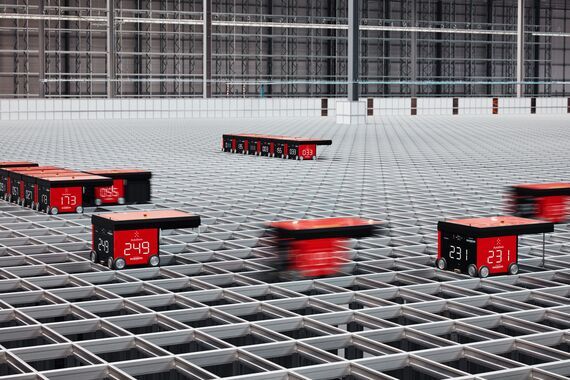
AutoStore is a cube-based automated storage and retrieval system (ASRS). Products are stored in bins stacked within a dense aluminium grid. Robots travel across the top of the grid, retrieving the correct bin and delivering it to an ergonomic workstation where an operator picks the item, without ever walking the warehouse floor.
THG Fulfil operates the world's highest output direct-to-consumer AutoStore facility, processing millions of orders annually across our global network. We have built and optimised AutoStore for the specific demands of high-growth ecommerce brands, and every client we work with benefits from that operational depth from day one.
AutoStore vs Manual Picking: What the Numbers Say
Space Efficiency
Manual shelving requires wide aisles for operator access. Those aisles account for a significant proportion of total floor space and contribute nothing to storage capacity.
AutoStore requires no pick aisles. The grid stores inventory in a fully vertical, compact configuration, using up to 75% less floor space than traditional shelving. For brands scaling into new markets and evaluating distribution footprints in the US or Europe, this directly affects property cost modelling. For brands operating in constrained UK facilities, it creates meaningful capacity headroom without a costly move.
Picking Accuracy
Human error is unavoidable in manual operations. Mispicks, labelling mistakes and misrouted orders are a persistent cost, generating returns, customer complaints and reputational damage.
In categories such as Beauty, Nutrition and Electronics, where product integrity and presentation are central to the consumer experience, mispick rates are not just an operational metric — they are a brand metric. A wrong shade of foundation or a mismatched electronic accessory does not just cost you a replacement; it costs you the relationship.
AutoStore delivers 99.99% picking accuracy through fully scanned inventory movements. Every bin retrieval and item pick is tracked and verified by our proprietary Warehouse Control System (WCS). This near-elimination of pick errors translates directly into lower returns rates, reduced customer service contact volume and stronger brand retention.
Throughput and Speed
Manual picking throughput is constrained by human capacity: the number of operators available, their speed, fatigue levels and the time required to travel between pick locations. Scaling throughput means scaling headcount.
AutoStore robots operate continuously, without fatigue. Throughput scales by adding robots to the existing grid, not by adding people. For a Head of Operations or Supply Chain Director managing rapid volume growth, this is the difference between a scalable system and one that requires constant firefighting.
Labour Costs and Dependency
Labour is typically the single largest variable cost in a manual fulfilment operation. It is also the most exposed to structural pressure: rising minimum wage legislation, recruitment challenges, seasonal availability constraints and the growing cost of temporary peak labour.
For CFOs and Heads of Procurement evaluating the true cost of fulfilment, labour dependency is not just a headcount problem — it is a financial exposure. AutoStore significantly reduces that exposure by replacing high-effort, low-skill pick walks with ergonomic, value-added workstation tasks. Fewer operators are required per unit of output, and the operators you do employ work more efficiently, with less physical strain and measurably better retention.
Peak Performance
Peak trading — whether Black Friday, Christmas gifting, subscription renewal cycles, or a major product launch — represents the highest-stakes period for any ecommerce operation. For brands in Beauty, Nutrition and Electronics, peak is not just a busy period; it is when consumer acquisition and brand reputation are most actively on the line.
Manual warehouses address peak by hiring temporary workers, which brings quality control risks, training overhead and management complexity. AutoStore scales by increasing robot throughput within the existing grid. At THG Fulfil, our peak simulation planning tools model demand scenarios well in advance, so AutoStore capacity is correctly configured before peak arrives, not during it.
International Expansion
For brands preparing to enter the US or European markets, fulfilment infrastructure is a critical strategic decision. Manual operations are difficult to replicate consistently across geographies. The quality standards, labour dynamics, compliance requirements and consumer expectations in each market are different, and manual processes do not travel cleanly.
AutoStore, integrated with THG Fulfil's global technology platform, provides a consistent, technology-led fulfilment standard across markets. The same accuracy levels, the same throughput capabilities, the same consumer experience, whether you are fulfilling from Manchester, a US distribution centre, or a European hub.
For brands that want the advantages of AutoStore without building or managing their own facility, outsourced fulfilment through a technology-led automated 3PL is the most direct route to market.
THG Fulfil is not a traditional 3PL. We are a fulfilment operating system, built over 20 years of running global commerce businesses at scale. Our AutoStore network was built to prove and optimise our own technology across billions in GMV and millions of orders — and every client benefits from that real-world operational intelligence from day one.
We manage the entire AutoStore journey: system design, installation, WCS integration, training, ongoing maintenance and continuous optimisation. For brands in Beauty, Nutrition, Electronics and beyond, this is the fastest and lowest-risk route to best-in-class automated fulfilment.
If your business is growing, labour costs are rising, or you are planning to enter a new market, the operational model that got you here may not be the one that takes you where you are going.
Manual picking served a purpose. For most high-growth ecommerce brands, that purpose is now behind them.
Want to explore how AutoStore could transform your fulfilment operation?
Talk to one of our automation experts today.