


Resource Type: Blogs
Tag: Fulfilment
BLOGS
Productivity up 200%. Error rates down 70%. Operating costs reduced by 77% over three years. These are not projections — they are the results of brands that moved to automated 3PL. If your fulfilment operation still runs on manual labour, here is what you are leaving on the table.
June 1, 2026
Resource Type: Blogs
BLOGS
Why Ecommerce Brands Are Moving to Automated 3PL Models
Productivity up 200%. Error rates down 70%. Operating costs reduced by 77% over three years. These are not projections — they are the results of brands that moved to automated 3PL. If your fulfilment operation still runs on manual labour, here is what you are leaving on the table.
June 1, 2026
The economics of ecommerce fulfilment are shifting. Here is what is driving ambitious brands to move to automated 3PL, and why the window for competitive advantage is narrowing.
The Hidden Cost of Staying Manual
Ask any operations leader at a scaling ecommerce brand to describe their peak period, and you will hear a version of the same story: more headcount, more errors, more chaos, and margin erosion that feels inevitable rather than preventable.
It is not a failure of management. It is a structural problem.
Manual warehouse operations carry a ceiling that becomes more visible the faster you grow. Pre-automation pick rates average 60 to 80 items per hour per associate, with performance degrading across a shift due to fatigue, unfamiliarity with SKU locations, and the compounding complexity of rising order volumes. Error rates of 1% to 2% sound trivial until you account for every replacement, every customer service escalation and every review left by a customer who received the wrong product. Traditional racking systems frequently utilise less than 25% of available warehouse cube. And, when peak season arrives, the only available response is to hire fast, train faster, and hope.
The result is a fulfilment model that becomes structurally less efficient as volume increases. For brands in beauty, nutrition, wellness, electronics, or any category defined by fast-moving SKUs and high customer expectation, this is not a sustainable operating model.
Ecommerce warehouse automation was always the answer. The challenge has been access.
Why Capital Investment Has Been the Barrier – Until Now
The case for warehouse automation is not contested. Businesses that have made the transition report:
- Productivity uplifts of up to 200%
- Error rate reductions of 70%
- System uptime consistently above 99.8%
AutoStore cube storage systems, autonomous mobile robots, and intelligent sortation technology have transformed fulfilment operations for those who can afford to build them.
Owning and operating advanced automation requires substantial upfront capital – typically tens of millions of pounds for a purpose-built facility. It requires specialist engineering teams, months of implementation, and the operational maturity to run complex robotics infrastructure at scale. For a fast-growing brand, diverting capital from product development, customer acquisition, or international expansion into warehouse infrastructure represents a significant and concentrated risk.
There is a further complication. The business case for automation is not always linear. Volumes need to reach a certain threshold before the economics work in your favour. Build too early, and you are paying for capacity you cannot fill. Wait too long, and your competitors who moved sooner are already operating at a cost and speed advantage you cannot easily close.
This is the dilemma that has historically locked most ecommerce brands out of warehouse automation. The performance benefits are real. The barriers to accessing them independently are equally real.
What an Automated 3PL Actually Delivers
The logic of outsourced fulfilment has always been sound: hand the operational complexity to a specialist and focus on what you do best. Where the traditional 3PL model has struggled is in delivering the performance levels that today's ecommerce brands demand.
An automated 3PL changes that proposition fundamentally.
Rather than absorbing capital expenditure yourself, you partner with a provider who has already made that investment, already worked through the implementation challenges, and already proven the technology at scale. You receive the output – faster throughput, greater accuracy, lower unit costs, and the capacity to flex during peak – without carrying the infrastructure risk on your own balance sheet.
The practical difference is significant. A well-operated automated 3PL, like THG Fulfil, can offer:
- 1am cut-off times for UK next-day delivery, compared to the 2pm or 3pm cut-offs typical of manual operations.
- Order accuracy rates above 99.9%, with robot-driven pick and pack eliminating the human error variability of traditional pick walks.
- Scalable capacity without headcount volatility, with robotic systems absorbing peak demand surges that would otherwise require weeks of temporary labour recruitment.
- Faster implementation timelines, with AutoStore systems commissionable in under five months and Libiao Robotics sortation technology deployable in as little as three weeks.
For a COO, logistics director, or head of operations, weighting the cost of staying manual against the risk of building your own automated facility, partnering with an automated 3PL removes the need to make that choice at all.
Robotics-as-a-Service: AutoStore Without Capital Investment
The commercial model that has made automated 3PL genuinely accessible to brands across the growth spectrum is Robotics-as-a-Service (RaaS).
Under a RaaS model, the capital cost of robotic infrastructure – the grid, the ports, the robots, the maintenance, the ongoing optimisation – sits with the 3PL provider. The brand pays an operating cost that reflects utilisation, converting what would otherwise be a multi-million-pound capital commitment into a predictable, scalable monthly expense.
This is not a theoretical proposition. It is the model underpinning how THG Fulfil operates as the UK’s only AutoStore Distributor offering RaaS to third-party clients.
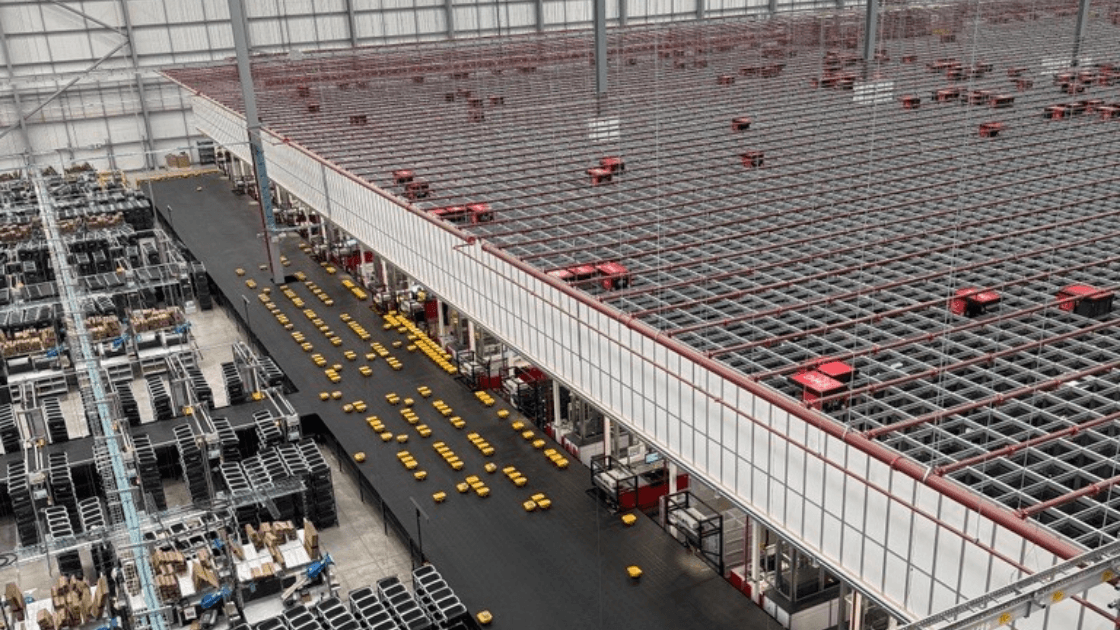
THG Fulfil has invested over £70 million in automation across its own fulfilment network, running AutoStore, Geek+ autonomous mobile robots, and Libiao Robotics intelligent sortation across facilities. The performance trajectory from that investment is well-documented: in the three years following the commissioning of an AutoStore system at its Manchester facility, operating costs fell 33% in year one, a further 21% in year two, and another 23% in year three – a cumulative reduction of 77%, achieved during a period in which UK labour rates rose by 30%.
Critically, THG Fulfil is not simply a technology distributor. It is currently the only AutoStore distributor in the UK that is also an active, at-scale end-user of the same systems it deploys for clients. That distinction matters. The operational knowledge that comes from running 120,000-bin AutoStore installations, 100 R5 Pro robots, 20 outbound ports, and real trading volumes across tens of millions or orders annually is not available from a vendor datasheet. It is the kind of insight that comes from problem-solving in production, not in a pilot environment.
For brands seeking AutoStore outsourced fulfilment – the performance of enterprise-grade robotics without the CapEx exposure – this is what that model looks like in practice.
Why Brands Are Moving Now
The shift towards automated 3PLs is not a trend confined to the largest players. It is being driven by a set of converging pressures that affect brands across the mid-market and growth stages.
Rising labour costs and availability. UK employment costs have increased substantially over the past three years, and the pipeline of warehouse labour is not expanding to match ecommerce growth. Brands relying on manual fulfilment are carrying a structurally increasing cost base.
Customer expectations have reset. Next-day delivery, accurate order fulfilment, and real-time visibility are no longer premium features. They are the baseline expectation. Brands unable to meet that baseline lose customers to those who can.
Global ecommerce growth is accelerating. Global online retail is projected to reach $6.88 trillion in 2026. The brands capturing disproportionate share of that growth are those whose fulfilment operations can scale without degrading.
Competitor automation is accelerating. Over 450,000 logistics robots were sold worldwide in 2025 – an increase of 500% compared to 2019. ABI Research forecasts 1.3 million RaaS installations by 2026. Brands that delay the transition to automated fulfilment are not holding a neutral position. They are falling further behind.
Capital efficiency has become a strategic priority. In a tighter funding environment, the ability to access automation performance without locking capital into warehouse infrastructure is a meaningful competitive advantage. The RaaS model makes that trade-off concrete.
For brands in beauty, nutrition, wellness, electronics, fragrance, or any category where fulfilment quality is directly linked to customer retention, the question is not whether to move to an automated 3PL model. It is how quickly, and with which partner.
Choosing the Right Automated 3PL Partner
Not all automation claims in the 3PL market carry equal weight. There is a meaningful difference between a provider that has installed automation and one that genuinely knows how to operate, optimise, and scale it under real trading conditions.
When evaluating an automated 3PL partner, the questions that matter most are:
- Does the provider operate this technology in its own fulfilment network, or does it simply resell or integrate third-party systems?
- Can it demonstrate compound performance improvement over multiple years, not just post-go-live metrics?
- Does its commercial model allow you to access automation without concentrating capital risk on your balance sheet?
- Does it back performance claims with contractual SLAs that hold throughout the contract term, not just at launch?
- How quickly can it implement, and what does service continuity look like during transition?
THG Fulfil fulfils over 150 million units annually, ships to customers across 195 countries, and operates a 1am UK next-day delivery cut-off with an average transit time of 1.45 days from order to doorstep. Customer contact rates – a direct measurement for fulfilment accuracy – have fallen 59% year on year. These are not projections. They are the live operating metrics of an automated fulfilment network.
The result, for brands that partner with THG Fulfil, is access to that performance through a commercial model designed to scale alongside your business, not one that requires you to bet heavily on your own balance sheet before knowing if the technology will work for you.
Fulfilment as Competitive Advantage
Fulfilment has historically been treated as a cost centre. The brands winning in ecommerce today understand it differently.
The operational capability to ship accurately, quickly, and at scale – consistently, not just in favourable trading conditions – is a direct driver of customer retention, repeat purchase rates, and brand reputation. In categories where the product experience is important and the post-purchase experience is equally so, the fulfilment operation is not a background function. It is part of the product.
Ecommerce warehouse automation, delivered through a credible automated 3PL partner, makes world-class fulfilment performance accessible without requiring you to become an expert in warehouse robotics. That is the shift that is underway. The brands moving now are not doing so because they have run out of alternatives. They are doing so because they recognise that the window to use automation as a competitive differentiator, rather than simply a cost of entry, is still open.
For how much longer is a reasonable question to ask.
Ready to explore what an automated 3PL could mean for your operation?
THG Fulfil is the UK's only AutoStore Distributor offering a full Robotics-as-a-Service model through an outsourced fulfilment partnership. If you are evaluating whether an automated 3PL is the right next step for your business, speak to our team.
Explore THG Fulfil's automation capabilities or get in touch to discuss your requirements.