


Resource Type: Blogs
Tag: Fulfilment
BLOG
The fulfilment industry has a positioning problem. Almost every operator now claims to be technology-led. Very few actually are. For brands in beauty, nutrition, and wellness, understanding the difference is one of the most commercially consequential decisions you will make.
June 9, 2026
Resource Type: Blogs
BLOG
Is RaaS the Answer to Beauty and Nutrition Fulfilment Complexity, or Just the Starting Point?
The fulfilment industry has a positioning problem. Almost every operator now claims to be technology-led. Very few actually are. For brands in beauty, nutrition, and wellness, understanding the difference is one of the most commercially consequential decisions you will make.
June 9, 2026
Contents
Contents
- Is RaaS the Answer to Beauty and Nutrition Fulfilment Complexity, or Just the Starting Point?
- Why RaaS fulfilment matters most for beauty and nutrition brands
- What RaaS fulfilment looks like in practice
- Why robots are the least important part of the RaaS decision
- THG Fulfil: Technology First
Contents
- Is RaaS the Answer to Beauty and Nutrition Fulfilment Complexity, or Just the Starting Point?
- Why RaaS fulfilment matters most for beauty and nutrition brands
- What RaaS fulfilment looks like in practice
- Why robots are the least important part of the RaaS decision
- THG Fulfil: Technology First
Contents
Contents
- Is RaaS the Answer to Beauty and Nutrition Fulfilment Complexity, or Just the Starting Point?
- Why RaaS fulfilment matters most for beauty and nutrition brands
- What RaaS fulfilment looks like in practice
- Why robots are the least important part of the RaaS decision
- THG Fulfil: Technology First
Contents
- Is RaaS the Answer to Beauty and Nutrition Fulfilment Complexity, or Just the Starting Point?
- Why RaaS fulfilment matters most for beauty and nutrition brands
- What RaaS fulfilment looks like in practice
- Why robots are the least important part of the RaaS decision
- THG Fulfil: Technology First
Robotics-as-a-Service (RaaS) is a subscription-based model that gives businesses access to warehouse robotics, automation infrastructure, and the software that orchestrates it, without the need for significant upfront capital investment. What was once reserved for brands with eight-figure budgets is now accessible to a much wider range of operations. Subscription access to goods-to-person robotics, AMR fleets, and AI-driven infrastructure has fundamentally altered the economics of ecommerce fulfilment.
But the removal of the capital barrier has also made it easier for conventional logistics operators to acquire isolated hardware, attach the language of automation to their proposition, and present themselves as something they are not.
The question worth asking is not whether your fulfilment partner has robots. It is whether technology genuinely sits at the centre of the operating model or whether automation has been layered onto a traditional logistics business to make the marketing more compelling. Applied to the right operation, with the right technology architecture behind it, warehouse automation is no longer an efficiency project; it is a strategic growth enabler. Applied poorly, it delivers very little of its potential.
Technology businesses that happen to operate warehouses are a fundamentally different proposition to logistics companies with technology attached. That distinction is becoming increasingly important, and nowhere more so than in beauty, nutrition, and wellness.
Why RaaS fulfilment matters most for beauty and nutrition brands
The conversation about warehouse automation tends to stay at the level of throughput and labour cost reduction. Those benefits matter; however, they are not where the greatest value sits. The real value emerges when automation addresses structural complexity. This is particularly relevant in beauty, wellness and supplements, where product portfolios, customer expectations and operational precision combine to create fulfilment environments that are increasingly difficult to manage manually.
Product and storage characteristics.
Beauty and nutrition products are typically compact, lightweight and relatively uniform in shape. These characteristics make them exceptionally well suited to high-density automated storage systems such as AutoStore. For brands managing hundreds or thousands of active SKUs across multiple formulations, variants, subscription plans and promotional bundles, storage density becomes a significant economic lever. Every cubic metre can be utilised more effectively, inventory becomes easier to access, travel time is dramatically reduced, and picking productivity increases without requiring additional warehouse space. In an environment where warehouse capacity, labour availability and property costs continue to rise, those gains compound quickly.
SKU complexity and variant precision.
The operational challenge for many beauty and nutrition brands is not simply moving products quickly. It is moving the right products accurately. Small differences in SKU configuration can create significant downstream consequences. A customer receiving the wrong supplement strength, skincare formulation or subscription variant is far more likely to contact customer service, request a refund or abandon future purchases.
As order complexity increases, manual operations become increasingly vulnerable to human error, particularly during peak trading periods where temporary labour is introduced at scale. Automated systems do not experience fatigue, they don’t forget processes and they don’t require weeks of onboarding to achieve consistent performance. The result is higher accuracy, stronger customer satisfaction and lower operational leakage. But only if the automation is genuinely engineered to handle that complexity, which brings us back to the questions of what the technology stack actually looks like underneath.
What RaaS fulfilment looks like in practice
Understanding what RaaS actually means in a live operation matters more than the concept itself. At THG Fulfil, our robotics infrastructure spans three core platforms, each deployed and operated in-house before being made available to clients. The performance data behind every system is real, not projected.
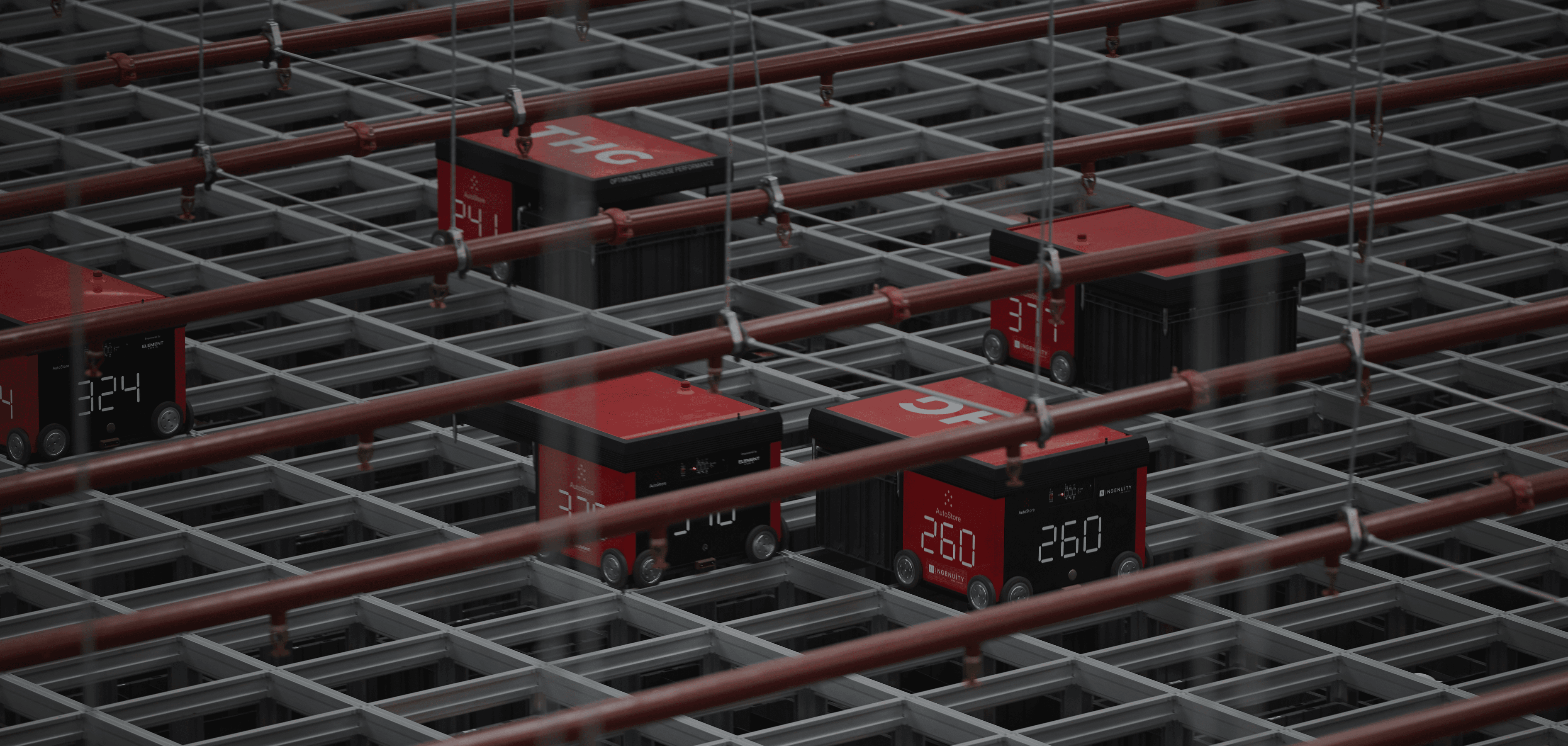
AutoStore sits at the foundation of the high-density storage operation. A cube-based automated storage and retrieval system, it delivers goods directly to operators, eliminating manual pick walls, supporting pick accuracy above 99.9%. For brands managing high SKU counts, this has a significant impact: AutoStore uses up to 75% less space than traditional shelving while delivering more than 200% productivity uplift versus manual operations. We currently operate the world’s highest output D2C AutoStore facility, meaning our deployment is backed by operational experience at a scale that very few providers can match.
Libiao Robotics handles intelligent outbound sortation, enabling flexibles batch sizing and direct-to-destination sorting that increases overall throughput. Our integrated Libiao systems have increased outbound capacity from 250,000 to 600,000 units per day in a single facility, with a deployment timeline of just 35 days. The combination of flexible robotics and rapid implementation enabled us to create a sortation model build not just for peak, but for sustainable, scalable growth.
Geek+ completes our robotic fleet. These autonomous mobile robots (AMRs) provide flexible goods-to-person picking across dynamic fulfilment environments. This intelligent handling is designed to handle evolving SKU profiles, supporting 2–3x productivity uplift over manual processes. They accommodate a wide range of storage configurations, from multi-shelf rack structures to specialist storage formats, allowing automation to be tailored to specific operational requirements.
What makes the RaaS model commercially relevant is the investment structure. Rather than requiring significant upfront CapEx, our OpEx model gives you access to this full robotics infrastructure on a subscription basis, with predictable operating costs, on-demand scalability during peak demand periods, and phased deployment. We have invested over £70 million in our own automation, and that investment is what removes the trial-and-error phase for our clients, replacing it with a proven deployment playbook.
The result is not just access to this hardware. It is access to the operational experience, proprietary WCS and WMS, and engineering partnerships with AutoStore, Libiao and Geek+ that turn the hardware into consistent, measurable performance.
Why robots are the least important part of the RaaS decision
Perhaps the biggest misconception in fulfilment today is that robotics alone create competitive advantage. They do not.
Robots are only as effective as the software layer coordinating them. The real differentiator sits within the technology stack that orchestrates inventory, orders, labour, automation assets and customer demand signals. Predictive replenishment reducing the operational risk of stockouts at critical moments, and client-facing data architecture surfacing the insight your commercial team needs to make decisions, not a monthly summary of metrics that tells you very little about what is actually happening in your operation. Without that software foundation, automation hardware is a throughput improvement. Not a transformation.
The most advanced fulfilment operations in 2026 are integrating AI directly into the orchestration layer, with systems reasoning about task sequencing, exception handling, and adaptive routing in ways that improve continuously. This matters because fulfilment complexity is not static. Beauty brands are introducing greater personalisation. Subscription models continue to evolve. New channels create additional fulfilment configurations. Customer expectations for speed and accuracy continue to rise. Static systems, including those built around hardware that an operator does not engineer or control, can’t adapt at the rate the market demands. But technology-led operators can, and the gap between those two things widens every quarter.
THG Fulfil: Technology First
THG Fulfil is not just another 3PL, it’s a technology-led fulfilment business. That is not a positioning statement, it is a description of how the operation is actually built and run.
The foundation is proprietary: a WMS and WCS developed and operated in-house, giving us end-to-end control of the intelligence layer that drives the operation. On top of that sit official distributor and deployment partnerships with Libiao Robotics and AutoStore; not hardware procurement relationships, but engineering partnerships that provide roadmap access, dedicated deployment capability, and the ability to scale robotic capacity in direct response to client requirements.
The consequence is an operation where every layer, robotics, orchestration software, data architecture, client reporting, is integrated and controlled. Performance data is meaningful because the systems generating it are ours. Scalability is genuine because the capacity model is built on infrastructure we develop and operate. The insight we provide to clients is actionable because the data flows through platforms built for that purpose.
Underpinning the technology is more than 20 years of ecommerce fulfilment experience, not as a legacy credential, but as the operational judgement to deploy automation where it delivers maximum value and maintain human expertise where it remains the right answer. In beauty and nutrition particularly, where fulfilment complexity is high and the commercial consequences of operational failure are direct, that judgement matters as much as the technology itself.
The most successful ecommerce businesses over the next decade will not treat fulfilment as a back-office function. They will treat it as strategic infrastructure; selecting partners based on technology roadmaps, engineering capability, and AI maturity alongside operational performance. The barrier to advanced automation is no longer capital investment. It is choosing a partner capable of turning that technology into a sustainable competitive advantage.
We believe the gap between genuinely technology-led fulfilment and conventional logistics with automation hardware is wider than most brands currently appreciate, and that it has direct consequences for the operational performance, customer retention, and commercial scalability of businesses in beauty, nutrition, and wellness. If that is a relevant consideration for your operation, explore THG Fulfil’s warehouse automation capabilities or get in touch, we would welcome the conversation.
Ready to evaluate your RaaS fulfilment options?
Speak to our team about what technology-led fulfilment looks like for beauty and nutrition brands.